The following is an excerpt from a Cosmic History question and answer dialogue regarding the re-thinking of the solar system (conducted in Self-Existing Seed year (2009).
RQ: … OK, now I am going to read a sentence and then ask for some definitions–so just say what first comes to you: “The galactic being is the whole galaxy reawakened in the superhuman. We are all the cells of the galactic being, a living atom out of which is formed the body of galactic being, which is the galaxy.”
Let’s first define galaxy: a galaxy is…
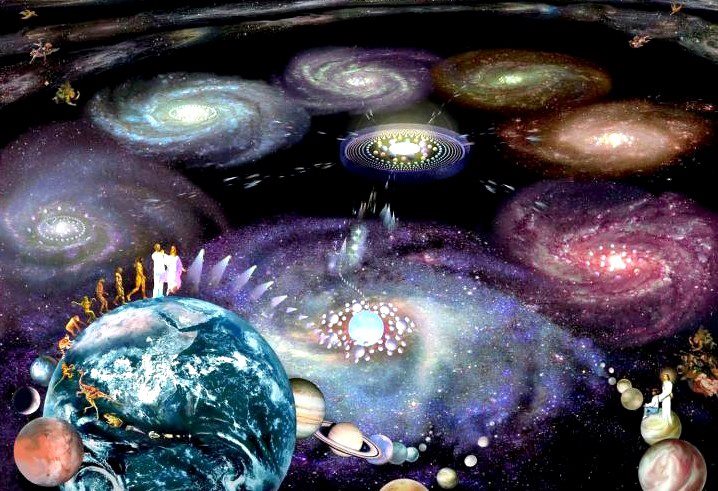
VV: A galaxy is the fundamental building block of the universe.
RQ: And the planets are?
VV: The planets are infinitesimally small electron light objects orbiting stars.
RQ: And so each of these small electron light objects have a specific function within the galaxy correct? Tell about this in light of the Law of Time.
VV: Yes, each of these (planet) bodies in time holds a certain planetary orbit. In light of the Law of Time the purpose of each planet is to hold specific levels or stages of consciousness. Consciousness is a function of different frequencies. For example, planetary frequencies are determined fundamentally by their relation to each other and their distance from each other.
RQ: Are you referring to their Bode number?
VV: Yes the Bode number are the ratios of the distance of the planets from each other and from the local star. But those frequencies then coordinate different levels or stages of consciousness. So we see consciousness is not just something that is solely in the human being’s brain, but is dispersed throughout the universe.
RQ: You have said before, from the fourth-dimensional viewpoint, that a planet is an atomic nucleus or electron that holds a particular frequency in place. The frequency pattern is the orbit. In this context can you please define “frequency?”
VV: Frequency in this context is the rate of vibratory oscillation of particular levels or kinds of analphs or thoughtforms. Every analph operates at a particular frequency. We are familiar mostly with third-dimensional analphs, which are relatively low frequency.
RQ: OK–Now can you describe how the planetary orbits are the “resonant frequency constants of the noosphere?” And also explain how one might one tune into these different planetary orbits to help trigger the noosphere?
VV: You have brought up the next word I was going to use, and that is “resonance.” When we talk about resonance we are talking about a minimum of two different entities or sources of vibrational frequency that are in some type of harmony or interaction. When we talk about the noosphere and planetary orbital frequency system, then we are saying that you cannot just isolate one planet and say it does not have relation to the rest of planets. The planetary system is one integrated orbital circuit. The sum of the resonant frequencies of all of the planets in relation to each other impacts the quality or resonance of the noosphere.
RQ: So to clarify–the noosphere consists of the sum of the interactions of the different planetary frequencies and their relationships to each other?
VV: Yes and in particular as they relate to the Earth.
RQ: OK, getting back to what you mentioned earlier: that the frequency of the planets is attributed to the Bode numbers. Can you say a bit more.
VV: Yes, the distance between the planets is a physical distance. When taken as a whole, the planets can be reduced to a set of intervals. And the intervals have a ratio in proportional relation to each other. So we are talking about the interval proportions of ratios of the planets to each other in relationship to the distance from the Sun.
For example Mercury has a Bode frequency of 4, Venus is 7; Earth is 10, and Mars is 16. So the relationship of Earth to Mercury is a 10:4 relationship. So 10:4 is quite a close relation. And the relation of Venus to Earth is 7:10, which is an even tighter ratio, even compared to the relation of Mars to Earth, which is a 16:10 ratio. So we can begin to look at the ratio intervals to see what kind of whole number frequencies they create.
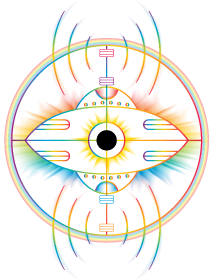
RQ: Great … so now let’s look at the five planetary circuits. Could you please give a bit more context on the study of these five circuits in relation to the activation of the noosphere. We just need a bit more context to see how this process works. [Circuits GRAPHIC]
VV: Again this goes back to the fact that the frequencies of the planets all create one large field of resonance. Within this large field of resonance every planet has some function or vibrational frequency. The circuits are the defining orders within the resonance. The circuits go from the outermost to the innermost. The outermost circuit is the alpha-omega circuit, the beginning and end. The orbits of these planets have double charges, a flow that goes in and a flow that goes out. So, the circuits give a sequence and formal order to the whole field of resonance. This formal order is then fractally, microscopically transmitted into the noosphere, so that it also organizes the noosphere.
RQ: OK, let’s talk for a moment about astrology … Many people who come to this system have a foundational base in traditional astrology. How do the astrological aspects and archetypes, such as Mercury is the messenger, relate to the synchronic order? How do you view this?
VV: Well, for the most part this may be. Why is Mercury associated with the messenger? Mercury’s orbital cycle is closest to the Sun and it also appears to move the fastest. And of course planet means “wandering star” because planets move faster than fixed stars. Mercury has an 88-day cycle. Because of this it becomes associated with the messenger of bringing communication. So the associations have some scientific validity, but beyond that it is questionable of what traditional astrology has to do with the planets.
What is interesting is the cycles of the planets, Mars has a 780-day synodic cycle when it appears in sky. Venus has the 584-day cycle including the appearance of the morning and evening star. And Saturn has the 378-day loops that it makes creating a Saturn return cycle of 29 years. So these are some of the more interesting facts, as they create a periodicity that creates a particular resonance.
RQ: So when we study this it is best to take away the myths and study the pure mathematics and ratios.
VV: Yes–it is good to clear the mind of preconceptions. For example, you can study the Bode numbers, the synodic cycles, the cyclical recurrences of planets, i.e. Uranus every 84 years, etc. This may be a more scientifically accurate way to contemplate the influence that each of the planets has on our psyche.
One influence of the planets are the different orbital positions of the planets in relation to each other. The influence of the other planets, like Earth, in their orbit and synodic, cyclical recurrence and relationship to the noosphere – they should have certain patterns there. Like the moon sets up a pattern every 28-29 days.
RQ: Do you feel the physical characteristics of the planets have anything to do with the quality of consciousness of that planet? For instance, Jupiter is the largest in mass or there is red dust on Mars, etc. do you feel these are important to also contemplate?
VV: Not as far as consciousness and psychology. What is interesting is that in the solar system that we are in, there are five inner planets (four plus asteroid belt) which are all relatively a small size. Then you have the four large planets. There’s a very distinct dividing line made by asteroid belt and inner planets and outer ones, with the exception of Pluto, the outer ones are giant compared to the inner planets.
GOD (Galactic Organizing Dynamic) does everything for a reason and everything has a purpose. So this system is designed so that the five inner planets were roughly the same size. And then there were at least four if not more outer planets, with the exception of Pluto, that are very large. But there is a clear distinction in size. (Of course Pluto has been officially downgraded to being a dwarf planet). This is interesting to contemplate psychologically with respect to the info associated with Pluto and the underworld. What is Pluto then and how does it affect the field?
What is most interesting to me about this system is that there is a very clear distinction between the asteroid belt the fifth planet and sixth planet Jupiter. What is the meaning of this? The planets are actually children of the sun and the planets have everything to do with the star system that they are arranged around, like the electrons going around a particular atom. If you have an atom and you stripped it of its electrons then it would cease to be the same element. By analogy if you take the planets and their orbits away from the Sun that has a big affect on the Sun. This would have a destabilizing effect.
to be continued…

![[Blue Resonant Night]](https://i0.wp.com/www.lawoftime.org/images/Kin163-big.png) Day out of Time: Kin 163, Blue Resonant Night
Day out of Time: Kin 163, Blue Resonant Night![[Yellow Galactic Seed]](https://i0.wp.com/www.lawoftime.org/images/Kin164-big.png) Galactic Synchronization: Kin 164, Yellow Galactic Seed
Galactic Synchronization: Kin 164, Yellow Galactic Seed![[Dr. Masaru Emoto with Stephanie South/Red Queen]](https://i0.wp.com/www.lawoftime.org/images/masaru-emoto-with-stephanie-south.jpg)

![[Biospheric Rights]](https://i0.wp.com/www.lawoftime.org/images/flt_logo.png)







 13:20 FREQUENCY SHIFT